Throughout this study I have shifted my belief about the significance of traditional diets several times, from assuming that traditional diets were a necessity, to reconsidering and assigning them an “aww shucks” level of nostalgia. Then in the last week of readings I have found an essay that verifies the co-evolution of desert dwellers with their foods. This was the evidence that I had expected to find throughout the research. I now consider a traditional diet significant due to the health benefits people can assume by subsisting on a diet of locally-available foods and for the cultural experience food provides and the informing of who the consumer has become.
The Luiseño Indians are comprised of seven bands from Southern California. Their native land stretched from the coast into the inland mountains and valleys. The Indians accessed different areas depending on seasonal food availability. Upon being displaced from their land and reassigned to an area of poor agricultural viability they were then supplied highly processed commodified food-like products by the U.S. government. This process has destroyed much of the Luiseño food tradition, contributing to widespread degradation of health. The agricultural tradition that does exist consists of large swaths of citrus and avocado trees that thrive on the rocky slopes of the area.
At the conclusion of this un-scientific research project, I believe that the Luiseño Indians have the most incentive to retain their traditional diets. Gary Paul Nabhan, a food anthropologist, has compiled compelling evidence that desert dwellers, as the Luiseño are, from Arizona, New Mexico and Australia have co-evolved with their native foods. This co-evolution allows for greater bioavailability of the nutrients contained within the plants. These peoples have eaten low-glycemic, complex carbohydrate, foods throughout their existence until the introduction of highly processed commodified food-like products. These products, made up of simple carbohydrates, are rapidly metabolized and stored as adipose tissue, causing diet-related diseases that have ravaged native communities, including the Luiseño. Despite all the compelling evidence, the Luiseño appear to be making limited attempts to reclaim their traditional diet. The Rincon Fiesta was an opportunity for the Band to celebrate their cultural heritage and build social capital within their community, but I experienced little attempt by the Band to do so. This observation is based on peripheral interaction with the members themselves. My attempts to learn from Pauma Band members were thwarted many times.
My experience with the Somali Bantus was the most extensive of the three groups and the most fulfilling. The Somali Bantus, having relocated to San Diego four to five years ago, maintain a strong connection to their traditional foods. Agricultural people in Africa; the Somali Bantus are continuing their tradition in their new home. Many of them are farming small plots at New Roots Community Farm in City Heights, San Diego. This farm is being used as an incubation program to find farmers who are interested and skilled enough to begin farming larger plots at Tierra Miguel Farm before moving onto land of their own. A group of 12 men and women recently visited Tierra Miguel to prepare for the training program.
I visited New Roots most recently during the Grand Opening celebration. At that time, I was shown the crops that are being grown by the farmers, beaming with pride. I was then introduced to some of the dishes that were prepared for the occasion. Sambusas stuffed with amaranth leaves and onion then lightly fried, were amazing. Amaranth was also steamed and served like spinach. Amaranth is a huge part of the Bantu diet and is believed to relieve arthritis pain that affects the joints of the lifelong farmers. The last dish I tried was a corn meal cake that is dipped in stewed okra and lima beans. This is regularly consumed as a midday meal and gives strength to the consumer. Okra is also thought to increase male virility. Many young members of the group have widened their food spectrum and now enjoy foods that were abstract when they first arrived, such as pizza. Cheese is uncommon in their native region, leading to its tentative introduction into their present diet, if at all.
Most cultures use festivals, holidays and celebrations to experience culture through food. In a culture that celebrates over 200 holidays, food traditions are celebrated daily. Jews who observe Shabbat have a weekly food ritual that involves preparing all the food on Friday afternoon that will be consumed between sunset Friday and sunset Saturday. There are also prescribed days of the week when Jews will enjoy fleishig (flesh) or milchig (milk) meals. Meat and dairy are never to be combined by observant Jews. This curiosity is due to the representation of life and death that milk and flesh respectively represent. Kosher food is that produced in accord with Jewish law. All fruits and vegetables are Kosher. Slaughtered animals, never pigs though, must be done so by the method known as shechitah to be considered Kosher. This method is supposedly painless to the animal.
The Seder meal, observed the first or second night of Passover, is the most commonly observed traditional meal for Jews. Each part of the menu is representative of their cultural history; four cups of wine, God’s liberation had four stages; at least three matzot, to remind of Abraham, Isaac and Jacob; karpas, a green vegetable such as parsley symbolizing spring and rebirth; haroset, a sweet mixture of dried fruit, nuts, apples and spices symbolizing the mortar that the slaves made for bricks in Egypt; maror, bitter herbs such as horseradish, representing the bitterness of slavery and beitzah, a roasted egg symbolizing a festival sacrifice brought in the days of the Temple (Blech 164).
Following the Judaic Diaspora, food continues to connect the people. Their traditional diet has undoubtedly been affected by their present locality but traditions shine through. I admire the pride and joy that their food history elicits. The few opportunities I have had to experience a traditional Jewish meal remain some of my favorite.
One of my readings this quarter, The Future of Food by Warren Belasco is a summary of theorized food and agricultural future states that have been written over the past two hundred years. Whether from the Cornucopian or Malthusian school, not one writer has theorized a future state that has come to fruition more than incidentally, such as approximate global population. Malthusians, doomsayers to some, believe that without dramatic population checks we will starve or be eating analogs made of wood chips or algae.
Cornucopians are technicists to the core, believing that science will always supply an answer. Scientific breakthroughs, increased yields, decreased labor, have allowed population to grow unchecked without generating total global hunger. Arguments against population control center around the need to continuously refill the population pool. By slowing population growth we will be decreasing the pool size from where the next generation of scientists will come. Food and agriculture have resisted the attempt by technicists to apply theoretical developmental models. As much as Americans love technicism, they do not want fully synthetic foods. Algae burgers and sawdust steaks are not as appealing to the palette as they are to the economics of production.
I consider myself a hybrid of the two. I believe that we, as a world community, will experience cornucopian amounts of food by harshly checking the population. I believe that the global carrying capacity is not more than half of our current rate. By increasing global education levels we can learn to enact responsible development practices through which regenerative ecosystems can flourish. Even without drastic population reduction, regenerative food systems will supply more food than can be consumed while improving ecosystem health whereby future populations will not want for delicious, healthful food.
Works Cited
Blech, Rabbi Benjamin (2003). Understanding Judaism. New York, N.Y: Alpha.
Showing posts with label Eating Group. Show all posts
Showing posts with label Eating Group. Show all posts
Tuesday, September 15, 2009

Tuesday, September 8, 2009
Discovering the Sweet Green Ball
The Luiseño diet is the one closest to me, physically. The Pauma Band of Luiseño Indians owns the property where I live and work. They have inhabited Pauma Valley and the surrounding areas forever. Of the three cultural groups that I am studying, co-evolution should be most prominent within their diet. Just a few miles from the farm are two other Luiseño reservations, Pala and Rincon. The annual Rincon Fiesta was held recently and I visited to see what types of food were being offered. In many cultures, festivals and holidays elicit traditional foods being prepared en masse that may have lost their place in the every day diet. At the Fiesta I found chicken, popcorn, watermelon and Mexican food; tamales, tacos, burritos. Nowhere did I see wiiwish, the sweetened acorn mash that had been a staple for California Indians nor wood rat that had been considered a delicacy.
Many of the reservations in the area are home to Mexican immigrants, so the introduction of Mexican food into the Luiseño diet is not unexpected. The Luiseño are an agricultural people, maintaining large swaths of citrus and avocado orchards to this day. Maize was one of the earliest South and Central American foods that spread north into present-day USA. Native peoples were the original bio-technicians, of course, cultivating teosinte and selecting to produce something far more reminiscent of today’s maize. In just 2,000 years, teosinte the size of a fingernail evolved into present-day maize. For that reason, popcorn does not strike me as being an odd food either.
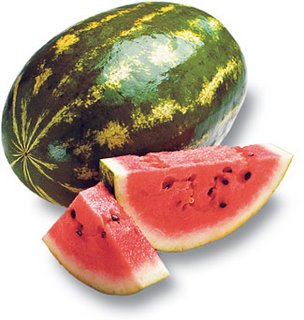
Whites introduced watermelon when they settled in California. The story of acceptance into the Luiseño diet asserts that an old Indian woman with a keen sense of smell had went out in search of an unfamiliar sweet scent that floated in on a breeze. She returned with a large green ball and volunteered to eat it first. If it was poisonous and she was to die, it would not matter because of her old age. She broke it open with a nearby stone and scooped the soft pink flesh into her mouth. She fell to ground, shaking and the others assumed she had died. But she opened her eyes and exclaimed it to be delicious and they all ate. The Indians saved the seeds and began to cultivate their own watermelons in Southern CA. The original “green ball” was believed to have grown from a seed that floated downstream from a field that a white man had planted.
Popcorn and watermelon are not foods that I think about in reference to traditional Indian diets, but they are part of the Luiseño past and Mexican food is prominently part of their present, as it is for most Southern Californians. These three foods were all introduced in distinct ways; popcorn through domestication of a wild plant and subsequent trade, watermelon, literally by chance, floated in on a stream and Mexican food was introduced through mass migration. Of these, watermelon represents the only food that was introduced by a single event.
Perhaps, time was the only limiting factor before whites, in need of supplemental protein, traded watermelon for wood rat. I will never know, but I do know that watermelon has persevered where wood rat has not. And likely, time remains the only barrier before watermelon is phased out in favor of another exotic food that thrives in the sandy soil of Pauma Valley. Evolution is a traditional aspect of all diets, be it through domestication (teosinte into maize), introduction (tamales and tacos) or chance (watermelon). The day will come when people long for the past when watermelon was the stereotypical summer food, before turning their attention back to whatever has taken its place.
Monday, September 7, 2009
No More Maize and Tomatoes!
As I approached this study, I expected to learn about co-evolution between plants and people and why specific diets have become prominent in certain areas. Maize is consumed nearly globally, but an entire diet, it does not make. If maize is not supplemented with other crops, the health of the consumer will quickly deteriorate. Rice and beans, peanut butter and jelly on wheat, these simple foods provide all the essential amino acids needed for a human to thrive. I wanted to learn what the Jewish and Somali Bantu versions of PB&J were.
I retain that co-evolution is important. It tells a story, but maybe it’s no longer the most significant aspect of traditional diets. The tradition itself, the tying of the present to the past is the most significant aspect. Our past has shaped who we are. Globalization has encouraged us to expand our dietary repertoire. Food, knowledge and people rapidly move around the globe, affecting all that they come in contact with. While I know not what the equivalent of a Somali PB&J is, I will continue to look until I achieve the satisfaction of tasting it.
In regards to promoting re-adoption of ones traditional diet, doing so may be irrelevant. A diet fit the needs of a specific set of circumstances, be it availability of goods or trade partners. The tomato was not widely accepted into Southern Italian cuisine until the 19th century. What would become of their traditional diet if I advocated for a reversion to pre-tomato days? That would surely be seen as a loss of tradition. The changing of diets is not evil; it is natural, not just among cultures but individuals as well. I retain concern when the change is so rapid that the physiology of a people is not able to evolve with the prominent foodstuffs in their diet. This is when diet-related diseases such as heart disease, diabetes and obesity run rampant. We must look to the past as we move forward, in life and in our food choices to avoid exposing ourselves to unintentional consequences that certain food choices elicit.
I retain that co-evolution is important. It tells a story, but maybe it’s no longer the most significant aspect of traditional diets. The tradition itself, the tying of the present to the past is the most significant aspect. Our past has shaped who we are. Globalization has encouraged us to expand our dietary repertoire. Food, knowledge and people rapidly move around the globe, affecting all that they come in contact with. While I know not what the equivalent of a Somali PB&J is, I will continue to look until I achieve the satisfaction of tasting it.
In regards to promoting re-adoption of ones traditional diet, doing so may be irrelevant. A diet fit the needs of a specific set of circumstances, be it availability of goods or trade partners. The tomato was not widely accepted into Southern Italian cuisine until the 19th century. What would become of their traditional diet if I advocated for a reversion to pre-tomato days? That would surely be seen as a loss of tradition. The changing of diets is not evil; it is natural, not just among cultures but individuals as well. I retain concern when the change is so rapid that the physiology of a people is not able to evolve with the prominent foodstuffs in their diet. This is when diet-related diseases such as heart disease, diabetes and obesity run rampant. We must look to the past as we move forward, in life and in our food choices to avoid exposing ourselves to unintentional consequences that certain food choices elicit.
Saturday, September 5, 2009
Summer School Can Be Dangerously Unproductive

As some of you might have noticed, I have not posted in a while. While the subjects I'm studying are interesting to me, I find myself saying "YES!" to social activities far more often than to homework. I've never been very good at studying during the summer. I remember having a list of books to read for high school and waiting until August to actually start them, cursing under my breath that I was missing out on the last few free days I had. This summer seems to be no exception.
Trying to buckle down I've spent some time at the UW library, reading through the Socologia Ruralis Journal that Britt suggested I look at. It sounds dull, right? For someone who's into agriculture and history and sociological phenomenas, this is like the jackpot. Suddenly, I'm reading about "Women in Rural Farming Communities", "Medicinal Folk and Foods in Southwestern Germany", and "Transcending the Gender Imbalance in Historical Agricultural Societies". HOLY CRAP, I've been studying the wrong subject and feel pulled to explore the roles of gender in agriculture. Who knew there was such a thing?!
For the most part, I have been sheltered from this issue by working in organic farming and often in egalitarian communities. Whenever I have stepped out this bubble, I attributed the shock at my ability to use a shovel or drive a tractor as a matter of ignorance and an exception, not as a rule to how the world works. Perhaps it was growing up in a home with muddled gender roles, it does not occur to me that women "can't do" certain things, or anything for that matter. It fascinates me to learn how others are pushed down because of their gender, be they women or men, and I feel compelled to explore this more. I'm not sure where this will take me, but I'm curious to find out...
Sunday, August 2, 2009
Insight into the Luiseno Diet
I have been at Tierra Miguel Farm in Pauma Valley, CA for over a year. Prior to this course, I had learned little about the natural history of the area. But I am using this opportunity to learn about the native foods that have been eaten for centuries and their significance to the native peoples of the region. The property that Tierra Miguel farms is owned by the Pauma Band of Luiseño Indians, one of seven bands of the Luiseno Indians. Before the times when cheap food could be quickly shipped around the world, people of all cultures had to depend upon locally available foodstuffs to make up most of their diet. Below are some traditional foods that the Luiseno have enjoyed since time immemorial.
From the Pauma Band website
( http://www.pauma-nsn.gov/pauma-tribal-culture.html ):
The Luiseño people enjoyed life in a land rich with diverse plants and animals. Our people have been described as hunters and gatherers.
The traditional territory of the Luiseño people extends along the coast, from the north near San Juan Capistrano, south to the Encinitas/Carlsbad area and east to the valleys of the coastal mountains and Mt. Palomar. Today this area is in northern San Diego, Riverside and Orange counties.
Tierra Miguel is growing domesticated versions of the following traditional Luiseno foods; roots, wild berries, wild grapes, strawberries, and wild onions. Currently growing at the farm are carrots, beets, radishes, potatoes, grapes, raspberries, strawberries and onions among many other items.
Wiiwish is the Luiseno food that I would most like to taste. My understanding is that it was a staple of their diet. Stay tuned to read about how wiiwish and other traditional food continue to be part of the Luiseno diet.
From the Pauma Band website
( http://www.pauma-nsn.gov/pauma-tribal-culture.html ):
The Luiseño people enjoyed life in a land rich with diverse plants and animals. Our people have been described as hunters and gatherers.


At the heart of our traditional foods is wìiwish, a tasty ground acorn mush and healthy food staple rich in protein. Evidence of acorn and seed processing and shellfish use dominates ancient sites throughout the Luiseño territory. The most visible evidence is the bedrock milling stone mortars used for processing seeds like acorns. These bedrock mortars sites are located throughout our region.
The traditional territory of the Luiseño people extends along the coast, from the north near San Juan Capistrano, south to the Encinitas/Carlsbad area and east to the valleys of the coastal mountains and Mt. Palomar. Today this area is in northern San Diego, Riverside and Orange counties.
Tierra Miguel is growing domesticated versions of the following traditional Luiseno foods; roots, wild berries, wild grapes, strawberries, and wild onions. Currently growing at the farm are carrots, beets, radishes, potatoes, grapes, raspberries, strawberries and onions among many other items.
Wiiwish is the Luiseno food that I would most like to taste. My understanding is that it was a staple of their diet. Stay tuned to read about how wiiwish and other traditional food continue to be part of the Luiseno diet.
Sunday, July 26, 2009
Thursday, July 23, 2009
Food is Culture
My introductory readings for this personal study were chosen to supply me with a historical baseline from where to proceed. Those readings are “Food is Culture” by Massimo Montanari, “Indians of the Oaks” by Melicent Lee and a short essay by Margaret Mead, “The Problem with Changing Diets.”
If “Food is Culture,” then what is culture? Montanari has a reply: “What we call culture takes it place where tradition and innovation intersect. Tradition is made up of knowledge, techniques, values, which were handed down to us. Innovation exists insomuch as this knowledge, these techniques, these values modify the place of man in the environmental context, rendering him able to experience a new reality (Montanari 7).”
This book is a short, fantastic piece that immediately set me back on my heels, forcing me to reevaluate assumptions that I held as I approached this course. I had hoped to learn about the diets of the peasantry, who would have made do with only locally available foodstuffs as opposed to the higher classes who could afford the high price of imported goods from traders. But what can I learn if no account has been made.
Because the lower classes did not commit their own experiences to writing but relied on oral transmission, they have seemingly left us nothing (Montanari 36). Theoretically speaking, orally transmitted cooking is destined not to leave traces of itself over time (Montanari 35).
Additionally, I expected that this course would solidify my belief that the introduction of new foods into traditional diets was mostly harmful. Montanari has challenged that belief.
The food system is therefore an extraordinary vehicle of self-representation and of cultural exchange. Food can serve as a mediator between different cultures, opening methods of cooking to all manner of invention, cross-pollination, and contamination (Montanari 133). Every culture, every tradition, every identity is a dynamic, unstable product of history, one born of complex phenomena of exchange, interaction, and contamination. Food cultures are so much richer and more interesting when the encounters and exchanges have been lively and frequent (139).
The writing of Melicent Lee did not disappoint either. “Indians of the Oaks” is a fictional story based upon the author’s time spent with members of the Kumeyaay Indians of present day Southern CA and Northern Mexico. I learned a great deal about the foods eaten by the Indians as well as the rituals that were equally important aspects of those meals. I look forward to my interview with a young tribal member of a Kumeyaay band to learn about his diet and his attempts to retain his food heritage.
Mead’s 20-page piece was a technical look into the physiological arguments of why retaining one’s traditional diet is most efficient. It was chock full of technicism and read longer than the immaculate 140 pages of Montanari. In retrospect, I would have chosen an alternative reading to begin the course as I do not feel that the essay delivered what it’s title evoked. I was relying on the author to reinforce my belief that Montanari had challenged and came away quite disappointed. As the old saying goes, don’t judge a book by its cover, or in this case, an essay by its title.
If “Food is Culture,” then what is culture? Montanari has a reply: “What we call culture takes it place where tradition and innovation intersect. Tradition is made up of knowledge, techniques, values, which were handed down to us. Innovation exists insomuch as this knowledge, these techniques, these values modify the place of man in the environmental context, rendering him able to experience a new reality (Montanari 7).”
This book is a short, fantastic piece that immediately set me back on my heels, forcing me to reevaluate assumptions that I held as I approached this course. I had hoped to learn about the diets of the peasantry, who would have made do with only locally available foodstuffs as opposed to the higher classes who could afford the high price of imported goods from traders. But what can I learn if no account has been made.
Because the lower classes did not commit their own experiences to writing but relied on oral transmission, they have seemingly left us nothing (Montanari 36). Theoretically speaking, orally transmitted cooking is destined not to leave traces of itself over time (Montanari 35).
Additionally, I expected that this course would solidify my belief that the introduction of new foods into traditional diets was mostly harmful. Montanari has challenged that belief.
The food system is therefore an extraordinary vehicle of self-representation and of cultural exchange. Food can serve as a mediator between different cultures, opening methods of cooking to all manner of invention, cross-pollination, and contamination (Montanari 133). Every culture, every tradition, every identity is a dynamic, unstable product of history, one born of complex phenomena of exchange, interaction, and contamination. Food cultures are so much richer and more interesting when the encounters and exchanges have been lively and frequent (139).
The writing of Melicent Lee did not disappoint either. “Indians of the Oaks” is a fictional story based upon the author’s time spent with members of the Kumeyaay Indians of present day Southern CA and Northern Mexico. I learned a great deal about the foods eaten by the Indians as well as the rituals that were equally important aspects of those meals. I look forward to my interview with a young tribal member of a Kumeyaay band to learn about his diet and his attempts to retain his food heritage.
Mead’s 20-page piece was a technical look into the physiological arguments of why retaining one’s traditional diet is most efficient. It was chock full of technicism and read longer than the immaculate 140 pages of Montanari. In retrospect, I would have chosen an alternative reading to begin the course as I do not feel that the essay delivered what it’s title evoked. I was relying on the author to reinforce my belief that Montanari had challenged and came away quite disappointed. As the old saying goes, don’t judge a book by its cover, or in this case, an essay by its title.
Tuesday, July 21, 2009
Food Justice

In response to Britt's comment about uploading videos, I want to share one that I think is phenomenal! Unfortunately, I can only give you the link to the website, http://www.mediathatmattersfest.org/watch/goodfood/food_justice_a_growing_movement.
Media That Matters hosts a film festival and all the videos are archived on their site. I encourage everyone to explore all the interesting and inspiring films available!!
Thanks,
s.
Monday, July 20, 2009
Are Traditional Diets Important?
Traditional diets connect people to their cultural history, but more significantly than that, peoples have co-evolved with food. The co-evolution of peoples with their place-specific diets has allowed the consumers to efficiently assimilate into themselves the necessary nutrients from regionally available foodstuffs. Changes in diet have consistently occurred over time, though on a gradual basis, in tune with the migration of people. New food items are introduced into diets by traders and travelers and if accepted have been cultivated when possible. Subsequent generations of the introduced crop become adapted to the region as well as to the people who inhabit it.
For those groups whose diets evolved more rapidly than the consumers, re-establishing a connection to the diet that they evolved with would contribute to the reduction in diet-related disease. Additionally a reconnection could act as a vector through which an increased connection to ones cultural history could be achieved. America has become so proficient at exporting its diet to the world, it has become desired globally. Now the foodstuffs alone do not suffice, the ideology is desired and has begun to permeate the belief systems of other regions as well. The efficiency of globalism in making the foodstuffs themselves and the ideology behind their production widely available has allowed for their adoption more rapidly than the novel consumers can evolve to efficiently utilize thus leading to disease in the forms of diabetes, heart disease and obesity.
Peoples that have immigrated to different global regions may not be able to maintain their traditional diet due lack of availability but their past could inform new food choices. There are several traditional meals that I can recall eating regularly as I grew up, none of which I consume any longer. The most immediate impact I may have on promoting other people to readopt their traditional diet, or a variance of it, would be to do so myself. By replicating traditional meals and the experience surrounding it; the gathering, preparing and eating of the food with others, I may prompt others to do the same.
For those groups whose diets evolved more rapidly than the consumers, re-establishing a connection to the diet that they evolved with would contribute to the reduction in diet-related disease. Additionally a reconnection could act as a vector through which an increased connection to ones cultural history could be achieved. America has become so proficient at exporting its diet to the world, it has become desired globally. Now the foodstuffs alone do not suffice, the ideology is desired and has begun to permeate the belief systems of other regions as well. The efficiency of globalism in making the foodstuffs themselves and the ideology behind their production widely available has allowed for their adoption more rapidly than the novel consumers can evolve to efficiently utilize thus leading to disease in the forms of diabetes, heart disease and obesity.
Peoples that have immigrated to different global regions may not be able to maintain their traditional diet due lack of availability but their past could inform new food choices. There are several traditional meals that I can recall eating regularly as I grew up, none of which I consume any longer. The most immediate impact I may have on promoting other people to readopt their traditional diet, or a variance of it, would be to do so myself. By replicating traditional meals and the experience surrounding it; the gathering, preparing and eating of the food with others, I may prompt others to do the same.
Muddling Through

These first few weeks will involve lots of reading on the history of Germanic tribes and researching what historians know about them and their culture. The first book I'm reading is called Before France and Germany by Patrick J. Geary and is a great preliminary read. One of the things that I've noted so far is the fact that the "Barbarians", as the Romans called them, did not have written history but relied on oral traditions. While this is not surprising, it proves to be difficult in truly understanding the Germanic culture before becoming "civilized". Geary points out that “when historians attempt to understand the barbarian world of late antiquity they must invariably turn to the written sources of their civilized neighbors, the Greeks and Romans…however…in describing the barbarian world, ancient ethnographers and historians had their own purposes and followed their own conventions that had little to do with what might today be called descriptive ethnography.” (39) The author goes on to describe how the Greeks and Romans saw the barbarians through a certain lens and often did not understand or misinterpreted their actions. Like a game of telephone spanning several centuries, there are invariably misprints and falsehoods that we have to muddle through to find understanding.
In reading this I feel thrown back to first quarter, talking about our mental models. How can we understand a people through the mental model of another, foreign culture? Is it even possible? Even if not, some of the descriptions the Romans gave are in the least entertaining: “They are generally tall, blond, and foul-smelling; they lived not according to fixed, written laws but according to senseless and unpredictable customs. They are fierce and dangerous in war, but slothful, easily distracted, and quarrelsome in peace.” (41) But I wonder, what is really going on here? If this description is accurate and I were to think of how this relates to German culture today, I would say that they are enjoying life. While modern Germans have a reputation for being hard workers, they also enjoy afternoon naps followed by coffee and cake and lively banter on the state of the world. I find it interested (though not surprising) that cultural misunderstandings have not gotten better over time. This churns my mind even further to think about cultural misunderstandings in my own life, specifically in Houston and the large Hispanic population. General stereotypes about all “Mexicans” abound in Southeast Texas because of cultural misunderstandings. But, I digress… the wheels are turning and its sure to be an interesting ride…
Food/Culture Group Guidelines
Group Members: Anise, Jonathan, & Stephanie
Blogging: Anise and Jonathan have separate blogs but will re-post those on the Coll. Methods blog so that we can all collaborate on the same forum. We will each post once a week and respond to each others' posts.
Meetings: Since we are all basing our studies on food, we'll meet once a month in a potluck or collaborative cooking setting while discussing our findings and further exploring our studies. For the final food/harvest ceremony Jonathan and Stephanie will aid Anise in leading the group.
Blogging: Anise and Jonathan have separate blogs but will re-post those on the Coll. Methods blog so that we can all collaborate on the same forum. We will each post once a week and respond to each others' posts.
Meetings: Since we are all basing our studies on food, we'll meet once a month in a potluck or collaborative cooking setting while discussing our findings and further exploring our studies. For the final food/harvest ceremony Jonathan and Stephanie will aid Anise in leading the group.
Saturday, July 18, 2009
 Over the course of the last few months I've come across the term, Anima Mundi, latin for World Soul. It peaked my curiosity and I decided to do a little research. Anima Mundi's meaning is very literal- this world, actually this universe, has a soul. It was first directly mentioned by Plato in his writing, Timeaus. Marcus Aurelius also spoke about it beautifully in his Meditations: “Constantly regard the universe as one living being, having one substance and one soul; ... and how all things act with one movement; and how all things are the cooperating causes of all things that exist; observe too the continuous spinning of the thread and the structure of the web.”
It seems the Anima Mundi is just one way of identifying an all-encompassing non-material form. The concept of the Anima Mundi seems very similar to pagan beliefs of the Great Mother, the Spirit of Creation, or the Divine feminine counterpart. There are theistic faiths that believe the universe is synonymous with an immanent God (pantheism, pan=all and theo=god). Some traditions of Christianity have been pantheistic. Panpsychistic beliefs contend that the whole universe possesses a mind or consciousness. Animism, common among folk faiths, is the belief that every thing in the universe possesses a soul.
A Sufi teacher, Llywellan Vaughn-Lee, explains that the Anima Mundi is the Macrocosm of the Universe and the Individual is the Microcosm. The spark of life and light in the Anima Mundi, is also the spark in us and in all things. He teaches that when the individual nourishes it's own soul, it also nourishes the World Soul.
I believe in the Anima Mundi. Whether it is God, the Divine Mother, or a Collective Consciousness, it doesn't really matter to me. What matters to me is that there is something that contains everything. A whole, more than the sum of its parts. I don't believe that anything, anything at all in this world is isolated from anything else. Everything is part of a great whole.
What disturbs me is that for quite sometime we humans (especially us Western ones) are trying very hard to prove that we are isolated. We do not tolerate being subject to the consequences of someone else's actions. We've built physical, mental and spiritual barriers around us everywhere we go to prove that we are invulnerable and not responsible for anything other than our individual selves.

This is why I love food. Not only is it pleasurable and satisfying, but it is a constant reminder that we are connected. And we can't run away from it, we have to eat! I believe, now more than ever, gardening and eating are healing acts because they can bring us back, over and over to the basic truth that we are part of the universal family. And when you choose to be open to this truth, you can no longer look at a carrot and just see a carrot. You see the hands that planted it. The soil and microbes that nourished it. The sun and rain that nurtured it. And then if you really look, in the carrot you can see yourself. It's the spark. The same spark in everything. The spark of the World Soul.
(Orginally posted on growfoodfeedspirit.blogspot.com)
Friday, July 10, 2009
Imaginary Lessons

A few months ago I was daydreaming about getting lessons from a great cook. I imagined a motherly french woman, who grew her food with patience and tenderness, harvesting it carefully and thankfully, and preparing it with creativity and affection. As I imagined our first lesson, I quickly knew what her first words of advice would be: “The most important element of relationship with food,” she says in a thick french accent, “is love.”
Call it a cliché, but I believe it's the truth. Isn't love the most important element of our relationship with anything, or anyone? Consider, when we are born one of the first things we do in relationship with another human being is eat. We are fed, most often, by someone who loves us. Sometimes, we are fed from their own bodies. If you have ever fed a baby, or watched them being fed, it is almost impossible to not sense the presence of love. The baby breathes in out steadily, fingers and hands grasping in the air, and eyes that stare up almost in awe. Somewhere along the way, especially in the West, the love element in our relationship with food is stripped away to the bare-bones of fuel, pleasure and satisfying craving. With all the distractions and triggers in life, love in food is forgotten, like it is forgotten in so many other places.
After experiencing my imaginary lesson with the motherly french cook, I tried to hold an intention of love when I interacted with food. I have many opportunities as it is my job and my primary responsibility at home. I also garden and harvest food, and yet like any meditation, putting it into practice is not as easy as it seems. Of course, there is love somewhere behind my daily interaction with food, but bringing it to the surface of my awareness is difficult. Still like any meditation, the very act of trying, over and over again, is as important as the end goal. It is a loving act in itself. And throughout this study, this is what I intend to do.
Yes, my study is about spirituality and agriculture, not explicitly love and agriculture. But in my mind love evokes the spirit, it calls it into the room, it is it's language, it's music. Love is the most important element in our relationship with food because it is the tie that binds our soul to food, to the Creation and her gifts, and to the people we give and share it with.
(This post was originally made at http://growfoodfeedspirit.blogspot.com ).
Subscribe to:
Posts (Atom)